There is no reliable fixed answer to how many tokens an AI coding agent uses for a task. A one line bug can take a long investigation if the cause is hidden. A larger looking change can be quick when the relevant files are clear. The prompt is only one part of the work, so estimate from a measured task rather than its word count.
What adds tokens during a coding session?
The model may receive your prompt, project instructions, selected files, earlier conversation, search results, terminal output, and test failures. It may generate a plan, code edits, tool calls, and a final explanation. If it reads the same context again on a later turn, the service may count that context again or apply a separate cached input rate.
A 2026 research preprint studying agentic coding tasks found large variation in token consumption, including cases where similar tasks differed substantially. That is useful evidence against a universal average, but it is a study of its benchmark and methods, not a prediction for every developer’s repository or product.
- The number of files the agent reads can matter more than the size of your prompt.
- A failed test may add logs and another round of context.
- Reasoning settings and model choice can change the amount of work behind an answer.
- An agent that edits and retests may make several model calls for one request.
Estimate your own usage from a real task
Choose a task you already need to do and record the product’s usage meter before and after. Note the repository, model, task description, files changed, retries, and tests. If the tool exposes input, cached input, and output separately, keep those values separate. If it shows only a credit balance, record that instead of trying to convert it into tokens.
Repeat with a small task and a multi file task. A couple of measurements will not predict every month, but they will show whether your normal work tends to be a quick edit or an extended agent session. Keep one example of a task that went smoothly and one that needed several corrections.
- Start with a saved project state and one clear acceptance test.
- Record the model, plan, and usage reading before the request.
- Let the agent finish, run the test, and include any retry in the same record.
- Record the final usage and the code you accepted after review.
Turn measured usage into a budget
For API billing, use the provider’s live input, cached input, and output rates for the model you actually selected. Multiply each usage amount by its matching rate, then add them. Do not use a single blended token price when the provider bills those categories differently.
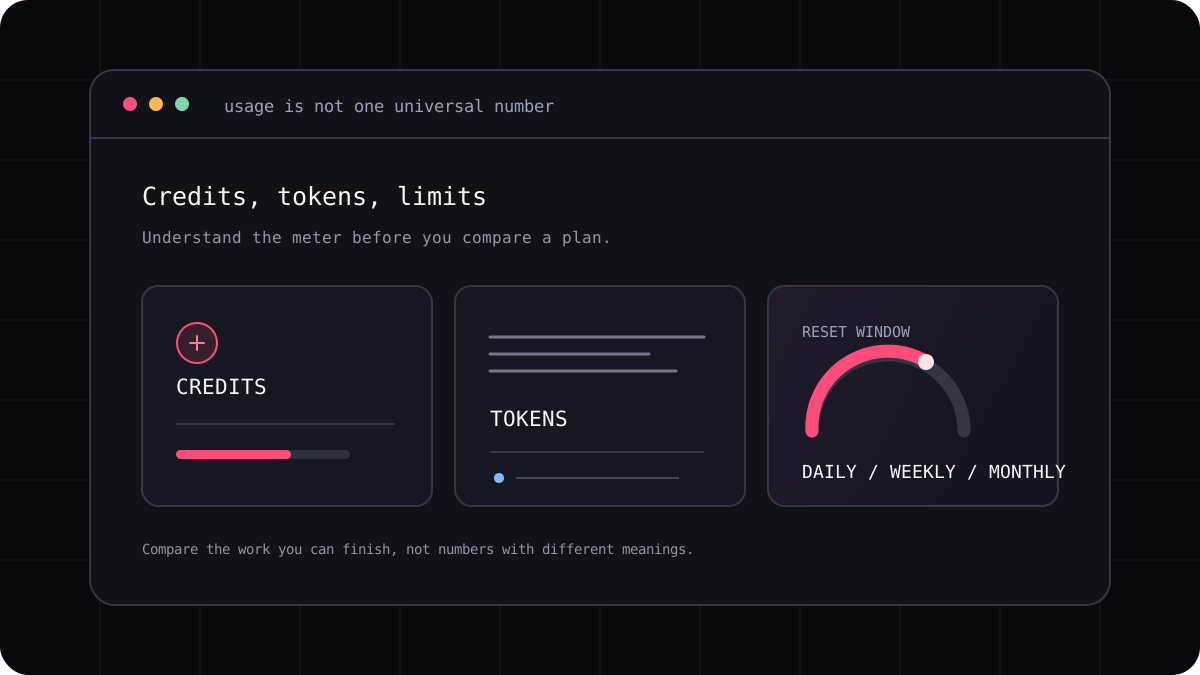
For subscription plans, your usage may be represented by a monthly credit pool, a rate limit, or a shared allowance rather than a per task bill. Record the product’s own meter and compare the work completed before and after the limit. LucentraCode publishes plan usage conditions, but its approximate allowance is not a promised task count or token conversion.
A prompt to adapt
Help me measure this coding task without changing the project first. Tell me which files and commands you expect to inspect. After the change, report the model, files read and edited, checks run, retries, and the usage value shown by this product. Do not estimate tokens if the usage screen does not provide them.Spend less without making the agent guess
Give the agent enough context to choose well, but keep the request focused. Name the behavior that should change, the behavior that must stay the same, and the check that will prove the result. Ask it to inspect relevant files before requesting a broad rewrite.
A concise prompt is helpful when it removes ambiguity. It is not helpful when it leaves out an important constraint and causes three repair rounds. Clear scope, useful project instructions, and a reviewable patch often save more than trying to force every task into one sentence.