
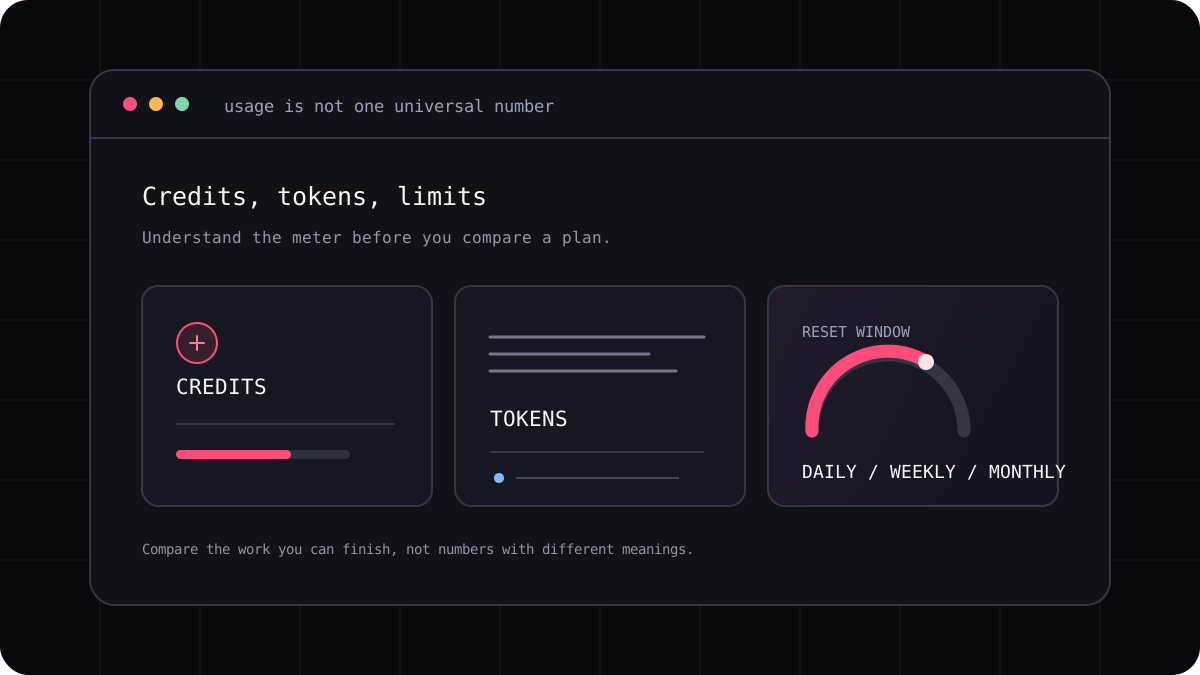
An AI coding plan may show credits, tokens, requests, chat hours, or a monthly allowance. Those words can sound like different names for the same thing, but they do not always mean the same thing. Before you compare two plans or try to estimate your bill, find out what the product counts and what a single coding session can consume.
Tokens are pieces of the conversation
A token is a unit used to process text and, in some systems, other content. Your prompt and the code sent to the model count as input. The model’s answer counts as output. Some services also report cached input when earlier context is reused. A coding agent may send repository files, tool results, test output, and previous messages along with your latest request.
That is why a small prompt can produce a large bill. “Fix this test” may be only four words, while the agent reads a long test file, several modules, configuration, and command output before it can respond. The work around the prompt can matter more than the prompt itself.
- Input tokens include what the model receives, such as instructions and code context.
- Output tokens include the model response and generated code.
- Cached tokens may be priced differently when context is reused.
- Tool calls and repeated turns can add more context to a coding session.
Credits are a product’s billing unit
A credit is defined by the company that sells the product. GitHub AI Credits are priced against model token use, with the model and number of tokens affecting the charge. A builder credit may instead represent a message, a successful edit, a feature action, or a mixture of work. One product’s credit is not automatically worth the same amount of work as another product’s credit.
Look for the provider’s explanation of its meter. Ask whether the balance is shared across products, whether models cost different amounts, when unused credits expire, and what happens after the included balance runs out. If a plan uses an approximate dollar value for usage, treat it as a vendor estimate rather than a guaranteed number of coding tasks.
| Term | What it may describe | Question to ask |
|---|---|---|
| Tokens | Model input, output, and sometimes cached context | Are the displayed tokens the model tokens or the product’s own estimate? |
| AI credits | A product specific balance that may be calculated from model use | Do models or features consume different amounts? |
| Requests or messages | An interaction allowance or request limit | Does a long agent task count as one request or several model calls? |
| Usage hours | Time allowed in a particular mode or experience | Which mode, reset window, and account tier does the hour limit cover? |
Read the full bill before you compare plans
A subscription can include a recurring allowance and charge separately for extra use. An API account may bill input and output at different rates. A hosted builder can count both app creation and the service that runs the finished app. Check those details together, especially if you plan to keep an app online after you finish building it.
If you are testing multiple tools, record the model and account path each time. Claude Code, for example, can use a subscription or supported API billing, and those paths have different limits and charges. Codex signed in with a ChatGPT account follows plan usage, while a personal API key uses API pricing.
- Open the live pricing and billing help page, not a screenshot of an old plan.
- Write down the included balance, reset date, and any overage rule.
- Check whether model choice changes the cost of a request.
- Run one ordinary task and review the usage record afterward.
A fair way to compare two “credit” plans
Use the same project and acceptance criteria in each tool. Compare the code that you kept, the corrections you made, the time the task took, and the displayed usage. If the services do not disclose a comparable measure, say so. It is better to compare a completed bug fix than to turn unlike credits into a pretend universal score.
A plan with fewer credits may still be a better fit if it gives you the model or workflow you need. The right question is not only “How many credits do I get?” It is “What work can I reliably finish before I meet the limit?”