Yes, an app built with AI assistance can become production ready. The method used to write the code does not decide whether it is safe or reliable. The evidence does. Before users depend on a vibe coded app, its behavior, data handling, security, accessibility, and recovery plan need the same care as any other software.
A working preview is not the same as a release
A preview proves that some path through the app works on one device with one set of data. Production use adds real accounts, unexpected inputs, network failures, concurrent users, data retention, and support needs. A beautiful screen can hide an insecure API route or a save button that silently loses information.
Write down what the app promises to do and what could harm a user if it fails. A personal prototype may only need a clear backup. A tool that handles payments, health information, or customer data needs a much deeper review and often a qualified engineer who can assess the design.
Review the parts people will depend on
Run the project’s tests, type checks, and build. Then test the main user journeys yourself, including empty states, invalid input, refreshes, and interrupted network requests. Ask what happens when a service is unavailable and whether the user can recover without losing work.
Review authorization at the server boundary, not just in the interface. Look for secrets in source files, unsafe input handling, permissions that are broader than needed, dependencies that the agent added without explanation, and logs that might capture private data.
- Check authentication, authorization, validation, and error handling.
- Confirm data ownership, retention, backup, and deletion behavior.
- Test keyboard access, readable labels, and small screen layouts.
- Review dependencies, environment variables, and deployment settings.
Use AI for the review without outsourcing the decision
Ask an agent to identify risks, generate tests, or explain an unfamiliar file. Then inspect the evidence yourself. A passing test suite only checks what the tests cover. It does not prove that every security rule or product requirement is correct.
Keep a reviewer who understands the data and the consequences of failure involved. For a critical flow, have another person review the code and the deployment configuration. OWASP guidance for AI assisted coding recommends treating generated code like code from any other source: inspect it, test it, and keep a human accountable for the result.
- List what the app must do and what it must never expose.
- Run automated checks and manually test the main user journeys.
- Review security, data, accessibility, and dependency choices.
- Prepare monitoring, backups, rollback, and a person who owns support.
A sensible path from prototype to launch
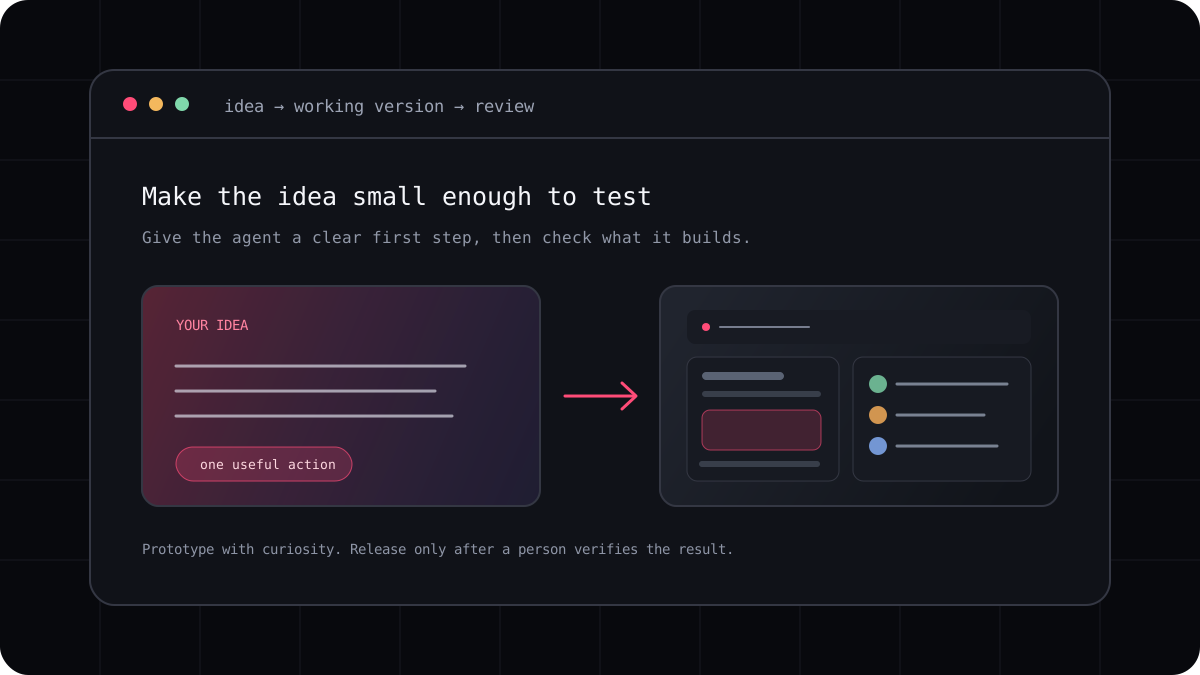
First make the prototype useful to one person. Next stabilize the data model, add tests for important behavior, and remove shortcuts that were acceptable only during exploration. Then stage the app with test data and make sure you can restore it if a release goes wrong.
AI can help at every step, especially when a developer gives it clear scope and checks each result. Production readiness comes from the engineering work around the generated code, not from the confidence of the tool that produced it.