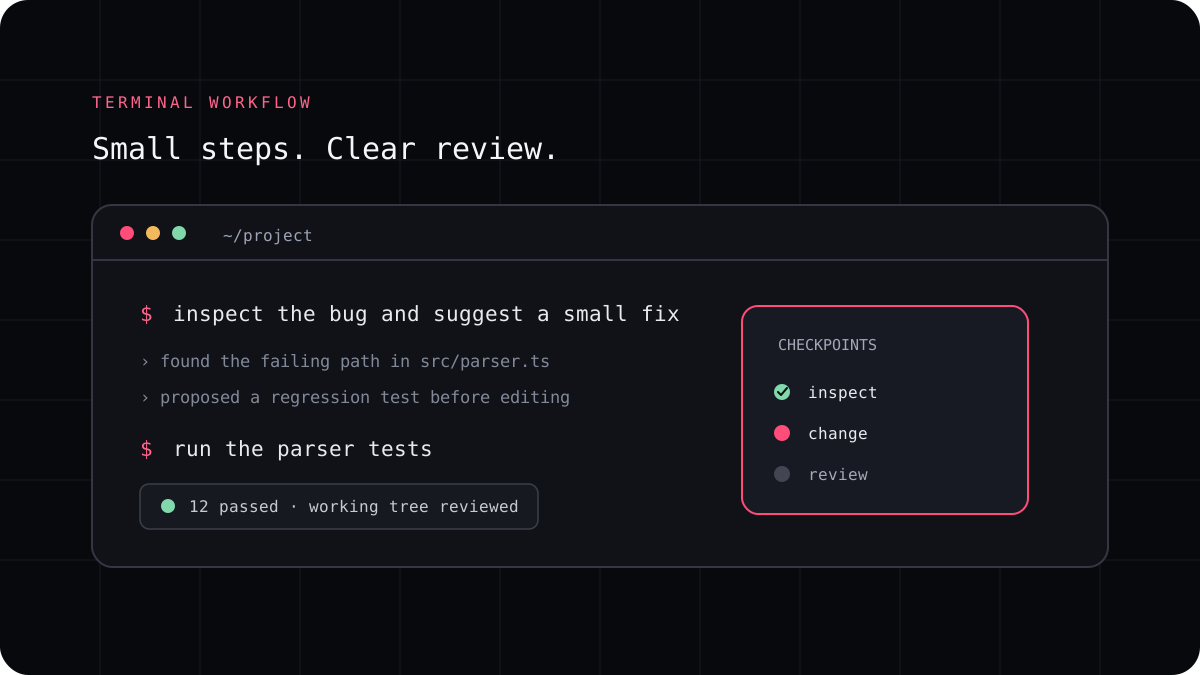
An AI coding CLI can run in a continuous integration job for bounded tasks such as summarizing test failures or preparing a change for review. Automation also removes the person who normally answers permission prompts. Before putting an agent in a pipeline, limit the task, credentials, network access, and actions it can perform.
Start with a task that can fail safely
Begin with a read only task such as explaining a failing test or checking whether a changelog entry is present. The output should help a developer decide what to do next. Once that works reliably, consider a patch that opens a reviewable branch or artifact rather than pushing directly to the default branch.
Avoid giving an agent a broad instruction to “fix the repository” in a workflow that runs on untrusted pull requests. Repository files and pull request text can contain instructions that try to influence the agent. Treat those inputs as data and keep access to secrets and privileged write tokens out of the run unless a specific approved design requires them.
Use structured output and a clean runner
A script needs predictable output. LucentraCode documents a JSON output mode for non interactive runs, which gives the calling job a structured response to capture. Run on a clean checkout, install only the required dependencies, and record the command and result with the job logs.
Store credentials in the CI secret manager and expose them only to the step that needs them. Use a token with the smallest permissions possible. Review network access and workflow triggers, especially jobs started by contributions from forks.
A prompt to adapt
lucentracode run --format json "run the repository checks and summarize failures without editing files"Keep generated changes behind a review gate
If an agent edits code, send the result to a branch or patch for review. Run the same tests and static checks that apply to a human authored change. A green job says that the configured checks passed; it does not prove the patch meets the product requirement or is safe to merge.
GitHub’s guidance for agentic workflows calls out least privilege, careful trigger design, and the risk of prompt injection from pull request content. Apply the same thinking to any CI provider. Separate code that proposes a change from the credential that can merge or deploy it.
- Use a disposable runner and a read only token for the first job.
- Limit the prompt to one task and return structured output.
- Run tests and checks after any generated edit.
- Require a person to approve merge, publish, or deployment actions.
When to use a hosted API instead of a CLI job
A local command is useful when the pipeline already runs the repository and needs a small agent task. If another service needs to trigger work, use the product’s documented API or integration instead of inventing an authentication path around a shell command. Keep API keys in secret storage and verify the endpoint, response schema, and rate limits for the current version.
LucentraCode documents CLI automation, a headless runtime, and API integrations. Start with the simplest supported route for your pipeline, keep a log of what ran, and leave consequential changes behind a review step.